Buy widgets.eu ?
We are moving the project
widgets.eu .
Are you interested in purchasing the domain
widgets.eu ?
domain@kv-gmbh.de · 0541-91531010
Buy widgets.eu ?
Is the technical diploma in automation technology difficult?
The difficulty of the technical diploma in automation technology can vary depending on the individual's background, experience, and aptitude for the subject matter. Some students may find the coursework challenging due to the complex concepts and technical skills required, while others with a strong foundation in math, science, and technology may find it more manageable. Overall, dedication, hard work, and a genuine interest in automation technology can help students succeed in completing the program. **
How are electronics technicians trained for automation technology?
Electronics technicians are trained for automation technology through a combination of formal education and on-the-job training. They typically complete a post-secondary program in electronics or a related field, where they learn about electrical circuits, digital electronics, and control systems. Additionally, they receive specialized training in automation technology, which includes learning about programmable logic controllers (PLCs), industrial robotics, and process control systems. This training may also involve hands-on experience with automation equipment and systems in a lab or industrial setting. Overall, electronics technicians are trained to understand and troubleshoot the complex systems used in automation technology. **


Similar search terms for Moscato
Top-Angebote
Products related to Moscato:
-
Moscato Giallo Franz Haas 2024The Moscato Giallo by Franz Haas is a fine and aromatic wine, with a nose that surprises with its olfactory evolution. The mineral structure combines with a good freshness on the palate, contributing to a smooth drinking experience. A white that is splendidly suited for tasting during the aperitif, but is also perfect for the entire meal, pairing well with light recipes, even slightly spicy ones. A bottle born from the winery's desire to experiment, demonstrating the passion that has always fueled its creative intentions. The Moscato Giallo Franz Haas comes from vines cultivated using the Guyot system in plots located at an altitude between 400 and 450 meters above sea level. We are in Mazzon, where the vines grow facing south, southwest, and west, rooting in a mixed subsoil, predominantly composed of sand and clay. After a very brief maceration, useful for extracting the aromatic qualities from the Moscato grapes, soft pressing is carried out. The must ferments in stainless steel at controlled temperature, where it then remains.to refine for five months on the fine lees, thus further enhancing its aromatic profile. At the end of this period, it is bottled and can finally reach the tables of all enthusiasts. The Moscato Giallo Franz Haas presents itself visually with a color reminiscent of gold, very bright. The fruit engages the nose with various nuances, also crossing exotic references, and then in the finish shifting towards a fragrance of aromatic herbs and flowers. On the palate, it is light-bodied, characterized by a dry and aromatic taste, fresh in its offering with a savory taste profile; it closes with a slightly almond-like finish. A label born in 2010 almost by chance, which after just a few vintages has already managed to carve out a significant importance in the range signed by Franz Haas.25,00 £*Shipping: 48,00 £Secure redirect to the provider
-
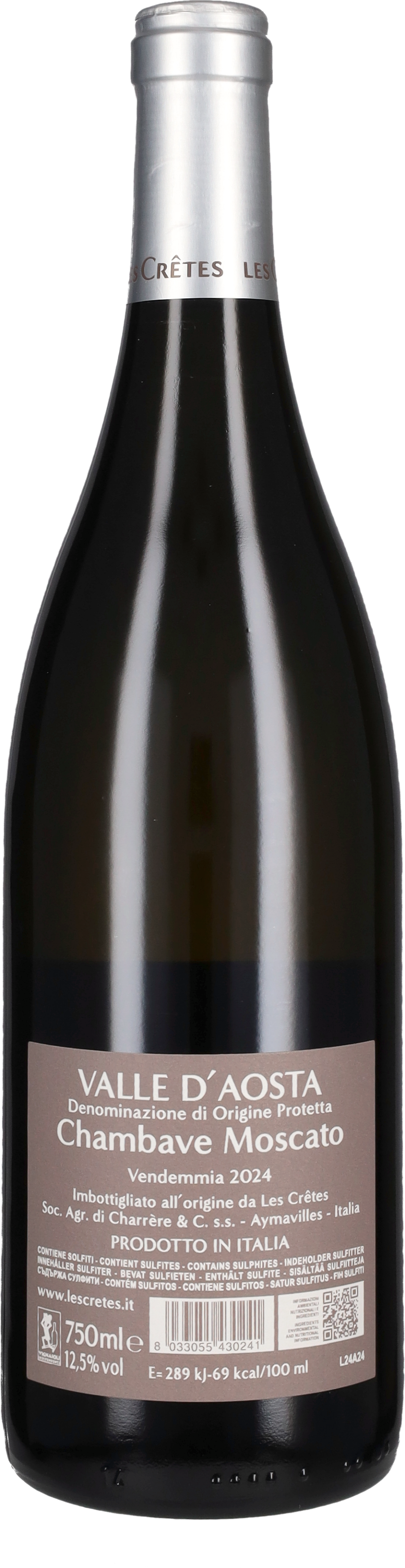
Chambave Moscato Les Cretes 2025The Chambave Moscato from the Aosta Valley estate Les Cretes is a dry white wine characterized by rich and sweet aromatic scents. The Chambave subzone, named after the small municipality located 20 kilometers east of the capital Aosta, is part of the Valle d'Aosta denomination and represents a prime area for Moscato Bianco, which here gives rise to some of the most interesting wines in the entire region. In fact, the locality has been renowned since the 15th century for its Moscato, traditionally vinified as passito as well as in a dry version. This was exported to nearby France, where it was also appreciated at the royal court. This is evidenced by a document stating that in 1494 Giorgio di Challant, a French cleric and patron, offered the Moscato Passito di Chambave to King Charles VIII of France. The Moscato Chambave Les Cretes is produced with only Moscato Bianco grapes grown at an altitude of about 500 meters above sea level on steep terraces. Following the harvest, the grapes are immediately transferred to the winery, where they are vinified through brief skin maceration and alcoholic fermentation in temperature-controlled stainless steel tanks. Still in stainless steel, the wine matures on the fine lees for 5 months, after which bottling takes place and further resting in glass precedes its market release. Visually, the Chambave Moscato from Les Cretes reveals a light and brilliant straw yellow hue. The aromatic bouquet is defined by fascinating varietal hints reminiscent of white peach, honeysuckle, lemon zest, sage, and thyme, enriched by a refined and subtle mineral vein. Tasting fresh and pleasantly savory, crisp and very fragrant, with a dry and juicy finish that invites further tastings.19,00 £*Shipping: 48,00 £Secure redirect to the provider
-
Moscato d'Asti La Caudrina 2025Il Moscato d’Asti della realtà produttiva La Caudrina è un’espressione fragrante e bilanciata, autentica manifestazione di questa celebre denominazione piemontese. Dopo decenni in cui Redento Dogliotti era impegnato nella vendita dei mosti da lui prodotti alla grande industria del Moscato d’Asti, sul finire degli anni ’70 arrivò la svolta per la tenuta di famiglia con il figlio Romano, il quale iniziò a vinificare in proprio dai vigneti più vocati e a imbottigliare con il suo nome, riscontrando subito un grande successo. Fu così che nacque il Moscato d’Asti La Caudrina, etichetta-simbolo della tenuta, la prima realizzata in assoluto dalla cantina. La Caudrina Moscato d’Asti nasce da sole uve Moscato Bianco, cresciute su terreni di matrice marnoso-calcarea a 280 metri sul livello del mare. I grappoli sono raccolti rigorosamente a mano e quindi subito pressati in maniera soffice, con il mosto così ottenuto che viene sottoposto a chiarificazioni e filtrazioni al fine di ottenere un liquido brillante. La massa è conservata in celle frigorifere fino al momento della fermentazione, che si svolge in autoclave a temperatura controllata con l’ausilio dei lieviti selezionati. La vinificazione e l’imbottigliamento sono eseguiti in condizioni isobariche, in modo tale da preservare la vivacità del vino. Alla vista, il Moscato d’Asti La Caudrina di Romano Dogliotti si presenta con una tonalità giallo paglierino carico. L’olfatto, di stampo aromatico, offre delicate sfumature floreali, alternate a note di agrumi canditi ed erbe aromatiche. In bocca risulta giustamente dolce, fresco e beverino, con una tenue effervescenza che anticipa la chiusura di buona persistenza. Come consuetudine per la tipologia, suggeriamo di gustare questo vino dolce in gioventù, magari nel periodo delle festività natalizie in accompagnamento ai classici pandoro e panettone.13,00 £*Shipping: 48,00 £Secure redirect to the provider
-
Moscato d Asti Massolino 2025ll Moscato d'Asti di Massolino è una raffinata ed elegante versione del vino dolce e vivace della grande tradizione piemontese. L’antico vitigno aromatico è coltivato da secoli nelle terre piemontesi, dove ha trovato terreni e clima per esprimere vini di particolare equilibrio. Il bouquet è caratterizzato da profumi di fiori bianchi, aromi d’agrumi, frutta bianca, sfumature vegetali di salvia e muschio. Il sorso è suadente e brioso, con frutto ricco, che si distende morbido al palato e trova la giusta armonia in un finale rinfrescante. E’ ottimo in abbinamento ai dolci tipici del territorio, come la torta di nocciole, di mele e pinoli oppure con della pasticceria secca o con i classici dolci natalizi. Il vino Moscato d'Asti è prodotto da Massolino con le pregiate uve che provengono dai vigneti di Serralunga d’Alba, nel cuore delle Langhe, dove la Cantina ha sede fin dal lontano 1896. Le vigne si trovano a un’altitudine di 320-340 metri sul livello del mare su terreni di matrice calcareo-argillosa. Le viti hanno un’età media attorno ai 20 anni e sono allevate a Guyot per una resa inferiore agli 80 quintali/ha. Dopo la vendemmia manuale, che per solito avviene nella seconda metà di settembre, i grappoli sono portati in cantina per la vinificazione. La fermentazione si svolge in tini d’acciaio a temperatura controllata e i vini base sono poi rifermentati in autoclave per mantenere intatto il profilo aromatico, fragrante e fruttato tipico del Moscato, senza modificare le sue note primarie più caratteristiche. ll Moscato d'Asti è il vino da dessert più famoso d’Italia, da sempre legato al concetto di festa e di convivialità. Il suo successo risiede nelle straordinarie qualità di un’uva aromatica e nel perfetto equilibrio gustativo tra dolcezza e freschezza. La Cantina Massolino produce il Moscato nella pregiata zona delle Langhe di Serralunga, terra storicamente legata alle grandi bottiglie di Barolo. Nel calice ha un colore giallo paglierino brillante, con una spuma sottile e delicata. Il bouquet ricorda profumi di zagara, biancospino, agrumi, pesca bianca, muschio, cenni vegetali di salvia e di erbe officinali. Al palato è morbido, con frutto dolce e maturo, ben contrastato da una vivace freschezza finale, che dona slancio alla beva.12,00 £*Shipping: 48,00 £Secure redirect to the provider



-
Is the electronics technician for automation technology difficult?
Becoming an electronics technician for automation technology can be challenging, as it requires a strong understanding of electrical systems, programming, and automation technology. The field is constantly evolving, so technicians must stay updated on the latest advancements and technologies. However, with dedication and the right training, individuals can develop the skills and knowledge needed to succeed in this role. It may be difficult at times, but the opportunities for growth and the potential to work on cutting-edge technology make it a rewarding career choice for those passionate about automation. **
-
What is the difference between automation technology and mechatronics?
Automation technology focuses on the use of control systems to operate equipment and processes with minimal human intervention. It involves the use of sensors, actuators, and controllers to automate tasks. Mechatronics, on the other hand, is a multidisciplinary field that combines elements of mechanical engineering, electrical engineering, and computer science to design and create intelligent systems. Mechatronics integrates mechanical systems with electronics and computer control to create advanced automated systems that can perform complex tasks. In summary, automation technology is a subset of mechatronics, which is a broader field encompassing a wider range of technologies and disciplines. **
-
Which CPU has good energy performance efficiency?
The AMD Ryzen 5000 series CPUs are known for their good energy performance efficiency. These CPUs are built on a 7nm process and feature a new architecture that delivers high performance while consuming less power. Additionally, they have advanced power management features that optimize energy usage, making them a good choice for users looking for energy-efficient CPUs. **
-
What is the difference between automation technology, PLC, and PCS7?
Automation technology refers to the use of control systems, such as PLC and PCS7, to automate industrial processes. PLC (Programmable Logic Controller) is a type of control system that uses a programmable memory to store instructions and execute specific functions, such as controlling machinery on a factory floor. PCS7 (Process Control System 7) is a specific type of automation technology developed by Siemens, which integrates various control systems and devices to monitor and control industrial processes in real-time. In summary, automation technology is the broader concept that encompasses the use of control systems like PLC and PCS7 to automate industrial processes, while PLC and PCS7 are specific types of control systems used in automation technology. **


Is the profession of automation technology electronics technician future-proof?
Yes, the profession of automation technology electronics technician is considered future-proof. With the increasing demand for automation in various industries, the need for skilled technicians to design, install, and maintain automated systems is expected to grow. As technology continues to advance, automation technology electronics technicians will play a crucial role in ensuring that these systems operate efficiently and effectively. Additionally, the skills and knowledge required for this profession are transferable to other emerging technologies, making it a versatile and in-demand career choice for the future. **
What is a specialist in information technology for system integration?
A specialist in information technology for system integration is a professional who is responsible for ensuring that different software systems and applications can work together seamlessly within an organization. They have expertise in integrating various technologies, databases, and applications to create a cohesive and efficient system. These specialists are skilled in identifying and resolving compatibility issues, designing interfaces, and implementing solutions to optimize system performance. Overall, their role is crucial in ensuring that all components of an organization's IT infrastructure work together effectively to support business operations. **
Top-Angebote
Products related to Moscato:
-
Moscato Giallo Erste+Neue 2025the characteristics of the grape variety. The maceration period with the skins is 6 hours, the alcoholic fermentation takes place at controlled temperature in steel tanks, where the subsequent aging also occurs. All operations are carried out without the presence of oxygen, to preserve the integrity of the grapes. The Moscato Giallo Erste+Neue is characterized by a pale straw yellow. Once poured into the glass, the aromas that reach the nose are primarily fruity, with sweeter notes of yellow peach, and more acidic citrus notes. There are also pronounced hints of mountain herbs, which evoke the spectacular landscapes of Alto Adige, with mountains and greenery. The bouquet is punctuated by some spicy notes that add an extra touch. On the palate, it is a fresh and delicate white, easy to drink, with mineral notes and the aromatic ones of Moscato. It has freshness and liveliness, and pairs excellently with fish, fresh cheeses, and vegetables. the characteristics of the grape variety. The maceration period with the skins is 6 hours, the alcoholic fermentation takes place at controlled temperature in steel tanks, where the subsequent aging also occurs. All operations are carried out without the presence of oxygen, to preserve the integrity of the grapes. The Moscato Giallo Erste+Neue is characterized by a pale straw yellow. Once poured into the glass, the aromas that reach the nose are primarily fruity, with sweeter notes of yellow peach, and more acidic citrus notes. There are also pronounced hints of mountain herbs, which evoke the spectacular landscapes of Alto Adige, with mountains and greenery. The bouquet is punctuated by some spicy notes that add an extra touch. On the palate, it is a fresh and delicate white, easy to drink, with mineral notes and the aromatic ones of Moscato. It has freshness and liveliness, and pairs excellently with fish, fresh cheeses, and vegetables.11,00 £*Shipping: 48,00 £Secure redirect to the provider
-
Moscato Giallo Franz Haas 2024The Moscato Giallo by Franz Haas is a fine and aromatic wine, with a nose that surprises with its olfactory evolution. The mineral structure combines with a good freshness on the palate, contributing to a smooth drinking experience. A white that is splendidly suited for tasting during the aperitif, but is also perfect for the entire meal, pairing well with light recipes, even slightly spicy ones. A bottle born from the winery's desire to experiment, demonstrating the passion that has always fueled its creative intentions. The Moscato Giallo Franz Haas comes from vines cultivated using the Guyot system in plots located at an altitude between 400 and 450 meters above sea level. We are in Mazzon, where the vines grow facing south, southwest, and west, rooting in a mixed subsoil, predominantly composed of sand and clay. After a very brief maceration, useful for extracting the aromatic qualities from the Moscato grapes, soft pressing is carried out. The must ferments in stainless steel at controlled temperature, where it then remains.to refine for five months on the fine lees, thus further enhancing its aromatic profile. At the end of this period, it is bottled and can finally reach the tables of all enthusiasts. The Moscato Giallo Franz Haas presents itself visually with a color reminiscent of gold, very bright. The fruit engages the nose with various nuances, also crossing exotic references, and then in the finish shifting towards a fragrance of aromatic herbs and flowers. On the palate, it is light-bodied, characterized by a dry and aromatic taste, fresh in its offering with a savory taste profile; it closes with a slightly almond-like finish. A label born in 2010 almost by chance, which after just a few vintages has already managed to carve out a significant importance in the range signed by Franz Haas.25,00 £*Shipping: 48,00 £Secure redirect to the provider
-
Chambave Moscato Les Cretes 2025The Chambave Moscato from the Aosta Valley estate Les Cretes is a dry white wine characterized by rich and sweet aromatic scents. The Chambave subzone, named after the small municipality located 20 kilometers east of the capital Aosta, is part of the Valle d'Aosta denomination and represents a prime area for Moscato Bianco, which here gives rise to some of the most interesting wines in the entire region. In fact, the locality has been renowned since the 15th century for its Moscato, traditionally vinified as passito as well as in a dry version. This was exported to nearby France, where it was also appreciated at the royal court. This is evidenced by a document stating that in 1494 Giorgio di Challant, a French cleric and patron, offered the Moscato Passito di Chambave to King Charles VIII of France. The Moscato Chambave Les Cretes is produced with only Moscato Bianco grapes grown at an altitude of about 500 meters above sea level on steep terraces. Following the harvest, the grapes are immediately transferred to the winery, where they are vinified through brief skin maceration and alcoholic fermentation in temperature-controlled stainless steel tanks. Still in stainless steel, the wine matures on the fine lees for 5 months, after which bottling takes place and further resting in glass precedes its market release. Visually, the Chambave Moscato from Les Cretes reveals a light and brilliant straw yellow hue. The aromatic bouquet is defined by fascinating varietal hints reminiscent of white peach, honeysuckle, lemon zest, sage, and thyme, enriched by a refined and subtle mineral vein. Tasting fresh and pleasantly savory, crisp and very fragrant, with a dry and juicy finish that invites further tastings.19,00 £*Shipping: 48,00 £Secure redirect to the provider
-
Is the technical diploma in automation technology difficult?
The difficulty of the technical diploma in automation technology can vary depending on the individual's background, experience, and aptitude for the subject matter. Some students may find the coursework challenging due to the complex concepts and technical skills required, while others with a strong foundation in math, science, and technology may find it more manageable. Overall, dedication, hard work, and a genuine interest in automation technology can help students succeed in completing the program. **
-
How are electronics technicians trained for automation technology?
Electronics technicians are trained for automation technology through a combination of formal education and on-the-job training. They typically complete a post-secondary program in electronics or a related field, where they learn about electrical circuits, digital electronics, and control systems. Additionally, they receive specialized training in automation technology, which includes learning about programmable logic controllers (PLCs), industrial robotics, and process control systems. This training may also involve hands-on experience with automation equipment and systems in a lab or industrial setting. Overall, electronics technicians are trained to understand and troubleshoot the complex systems used in automation technology. **
-
Is the electronics technician for automation technology difficult?
Becoming an electronics technician for automation technology can be challenging, as it requires a strong understanding of electrical systems, programming, and automation technology. The field is constantly evolving, so technicians must stay updated on the latest advancements and technologies. However, with dedication and the right training, individuals can develop the skills and knowledge needed to succeed in this role. It may be difficult at times, but the opportunities for growth and the potential to work on cutting-edge technology make it a rewarding career choice for those passionate about automation. **
-
What is the difference between automation technology and mechatronics?
Automation technology focuses on the use of control systems to operate equipment and processes with minimal human intervention. It involves the use of sensors, actuators, and controllers to automate tasks. Mechatronics, on the other hand, is a multidisciplinary field that combines elements of mechanical engineering, electrical engineering, and computer science to design and create intelligent systems. Mechatronics integrates mechanical systems with electronics and computer control to create advanced automated systems that can perform complex tasks. In summary, automation technology is a subset of mechatronics, which is a broader field encompassing a wider range of technologies and disciplines. **
Similar search terms for Moscato
-
Moscato d'Asti La Caudrina 2025Il Moscato d’Asti della realtà produttiva La Caudrina è un’espressione fragrante e bilanciata, autentica manifestazione di questa celebre denominazione piemontese. Dopo decenni in cui Redento Dogliotti era impegnato nella vendita dei mosti da lui prodotti alla grande industria del Moscato d’Asti, sul finire degli anni ’70 arrivò la svolta per la tenuta di famiglia con il figlio Romano, il quale iniziò a vinificare in proprio dai vigneti più vocati e a imbottigliare con il suo nome, riscontrando subito un grande successo. Fu così che nacque il Moscato d’Asti La Caudrina, etichetta-simbolo della tenuta, la prima realizzata in assoluto dalla cantina. La Caudrina Moscato d’Asti nasce da sole uve Moscato Bianco, cresciute su terreni di matrice marnoso-calcarea a 280 metri sul livello del mare. I grappoli sono raccolti rigorosamente a mano e quindi subito pressati in maniera soffice, con il mosto così ottenuto che viene sottoposto a chiarificazioni e filtrazioni al fine di ottenere un liquido brillante. La massa è conservata in celle frigorifere fino al momento della fermentazione, che si svolge in autoclave a temperatura controllata con l’ausilio dei lieviti selezionati. La vinificazione e l’imbottigliamento sono eseguiti in condizioni isobariche, in modo tale da preservare la vivacità del vino. Alla vista, il Moscato d’Asti La Caudrina di Romano Dogliotti si presenta con una tonalità giallo paglierino carico. L’olfatto, di stampo aromatico, offre delicate sfumature floreali, alternate a note di agrumi canditi ed erbe aromatiche. In bocca risulta giustamente dolce, fresco e beverino, con una tenue effervescenza che anticipa la chiusura di buona persistenza. Come consuetudine per la tipologia, suggeriamo di gustare questo vino dolce in gioventù, magari nel periodo delle festività natalizie in accompagnamento ai classici pandoro e panettone.13,00 £*Shipping: 48,00 £Secure redirect to the provider
-
Moscato d Asti Massolino 2025ll Moscato d'Asti di Massolino è una raffinata ed elegante versione del vino dolce e vivace della grande tradizione piemontese. L’antico vitigno aromatico è coltivato da secoli nelle terre piemontesi, dove ha trovato terreni e clima per esprimere vini di particolare equilibrio. Il bouquet è caratterizzato da profumi di fiori bianchi, aromi d’agrumi, frutta bianca, sfumature vegetali di salvia e muschio. Il sorso è suadente e brioso, con frutto ricco, che si distende morbido al palato e trova la giusta armonia in un finale rinfrescante. E’ ottimo in abbinamento ai dolci tipici del territorio, come la torta di nocciole, di mele e pinoli oppure con della pasticceria secca o con i classici dolci natalizi. Il vino Moscato d'Asti è prodotto da Massolino con le pregiate uve che provengono dai vigneti di Serralunga d’Alba, nel cuore delle Langhe, dove la Cantina ha sede fin dal lontano 1896. Le vigne si trovano a un’altitudine di 320-340 metri sul livello del mare su terreni di matrice calcareo-argillosa. Le viti hanno un’età media attorno ai 20 anni e sono allevate a Guyot per una resa inferiore agli 80 quintali/ha. Dopo la vendemmia manuale, che per solito avviene nella seconda metà di settembre, i grappoli sono portati in cantina per la vinificazione. La fermentazione si svolge in tini d’acciaio a temperatura controllata e i vini base sono poi rifermentati in autoclave per mantenere intatto il profilo aromatico, fragrante e fruttato tipico del Moscato, senza modificare le sue note primarie più caratteristiche. ll Moscato d'Asti è il vino da dessert più famoso d’Italia, da sempre legato al concetto di festa e di convivialità. Il suo successo risiede nelle straordinarie qualità di un’uva aromatica e nel perfetto equilibrio gustativo tra dolcezza e freschezza. La Cantina Massolino produce il Moscato nella pregiata zona delle Langhe di Serralunga, terra storicamente legata alle grandi bottiglie di Barolo. Nel calice ha un colore giallo paglierino brillante, con una spuma sottile e delicata. Il bouquet ricorda profumi di zagara, biancospino, agrumi, pesca bianca, muschio, cenni vegetali di salvia e di erbe officinali. Al palato è morbido, con frutto dolce e maturo, ben contrastato da una vivace freschezza finale, che dona slancio alla beva.12,00 £*Shipping: 48,00 £Secure redirect to the provider
-
Moscato Giallo Dolce Tramin 2025Tramin winery's Moscato Giallo Dolce is a dessert wine made from a variety of Moscato grapes that has been grown in Alto Adige for centuries. It is a very interesting nectar, characterized by a delicate sweetness that is very well balanced by freshness. Its soft floral and fruity aromas, hints of tropical fruit and aromatic notes express a harmonious bouquet and give a slightly sweet sip, which retains a pleasant drinkability without ever tiring. It is a sweet wine of great elegance and lightness, ideal to accompany a strudel, apple pie and, more generally, desserts that are not overly cloying. The sweet Moscato Giallo wine from the Tramin winery is the fruit of one of the most interesting cooperatives in South Tyrol. The Tramin winery consists of 300 members and can count on a vineyard park of about 260 hectares, which are mainly located in the Tramin area. The different altitudes, soil compositions and microclimates allow each grape variety to be cultivated in the most suitable place so that high quality grapes are always obtained. Thanks to this richness and variety, the wines of the Tramin winery have established themselves with an ever-growing public of wine lovers who appreciate, above all, the authenticity of expression and high quality. Tramin Moscato Giallo Dolce comes from vines cultivated in a hilly area between 250 and 550 meters on soils of mainly limestone matrix with the presence of gravel and clay. The grapes reach ripeness with very rich aromatic kits, thanks to the considerable temperature ranges between day and night. At the end of the harvest, the grapes are softly pressed, and the must is fermented in temperature-controlled steel vats. Before bottling, the wine matures for a few months in steel. In the glass, it has a light straw yellow colour with brilliant reflections, and the nose recalls aromas of white fruit, peach, cartucciaro melon, spicy sensations and floral notes. The palate is soft and elegant, with a persuasive sip, richly fruity and pleasantly sweet. The finish is very harmonious, fresh and savoury. Tramin wines are now recognized as true ambassadors of Alto Adige.13,00 £*Shipping: 48,00 £Secure redirect to the provider
-
Moscato Rosa Franz Haas 2024 - 50clThe Moscato Rosa by Franz Haas is a sweet, fruity and floral caress, spontaneous and genuine. Just as its residual sugar is, which does not come from overripening or drying, but is part of the identity characteristics of this grape variety. If harvested at full ripeness, the Moscato Rosa grape is naturally enriched with an abundant and pleasant sugar content, making it naturally suitable for the production of sweet wines. The limited production of this label emphasizes the rarity and precious value of this nectar, which carries the fragrant charm of roses and the freshness of the South Tyrolean mountains. Franz Haas Moscato Rosa is made from grapes coming from an area located in the municipality of Egna, in the province of Bolzano. Positioned at an altitude of 250-300 meters above sea level, these vineyards have excellent ventilation, necessary to prevent the development of mold, and a soil defined by a mixture of porphyry, sand, clay, and limestone. After harvesting, the grapes are pressed and the must is placed to macerate briefly in contact with its own skins. In steel containers, alcoholic fermentation begins, which is interrupted with the help of low temperatures upon reaching the desired characteristics. A final resting in steel allows the Moscato Rosa to refine its qualities. The Moscato Rosa by Franz Haas presents a bright ruby red color. Its aroma is intriguing and complex, playing on notes of rose and orange peel, set against a spicy backdrop of cinnamon and cloves. A full body showcases a beautiful balance of sweetness and freshness, enlivened by a hint of tannin. It is said that pairing with chocolate is one of the most difficult: this Moscato Rosa, by Franz Haas, will succeed in the endeavor.33,00 £*Shipping: 48,00 £Secure redirect to the provider
-
Which CPU has good energy performance efficiency?
The AMD Ryzen 5000 series CPUs are known for their good energy performance efficiency. These CPUs are built on a 7nm process and feature a new architecture that delivers high performance while consuming less power. Additionally, they have advanced power management features that optimize energy usage, making them a good choice for users looking for energy-efficient CPUs. **
-
What is the difference between automation technology, PLC, and PCS7?
Automation technology refers to the use of control systems, such as PLC and PCS7, to automate industrial processes. PLC (Programmable Logic Controller) is a type of control system that uses a programmable memory to store instructions and execute specific functions, such as controlling machinery on a factory floor. PCS7 (Process Control System 7) is a specific type of automation technology developed by Siemens, which integrates various control systems and devices to monitor and control industrial processes in real-time. In summary, automation technology is the broader concept that encompasses the use of control systems like PLC and PCS7 to automate industrial processes, while PLC and PCS7 are specific types of control systems used in automation technology. **
-
Is the profession of automation technology electronics technician future-proof?
Yes, the profession of automation technology electronics technician is considered future-proof. With the increasing demand for automation in various industries, the need for skilled technicians to design, install, and maintain automated systems is expected to grow. As technology continues to advance, automation technology electronics technicians will play a crucial role in ensuring that these systems operate efficiently and effectively. Additionally, the skills and knowledge required for this profession are transferable to other emerging technologies, making it a versatile and in-demand career choice for the future. **
-
What is a specialist in information technology for system integration?
A specialist in information technology for system integration is a professional who is responsible for ensuring that different software systems and applications can work together seamlessly within an organization. They have expertise in integrating various technologies, databases, and applications to create a cohesive and efficient system. These specialists are skilled in identifying and resolving compatibility issues, designing interfaces, and implementing solutions to optimize system performance. Overall, their role is crucial in ensuring that all components of an organization's IT infrastructure work together effectively to support business operations. **
* All prices are inclusive of VAT and, if applicable, plus shipping costs. The offer information is based on the details provided by the respective shop and is updated through automated processes. Real-time updates do not occur, so deviations can occur in individual cases. ** Note: Parts of this content were created by AI.